Private collections, not public posts
A shared collection is a private feed inside Kindred that only invited people can see. Photographs from a holiday, a birthday, a new baby, visible to the family and nobody else.
There's no public post to make, no privacy setting to get wrong, and no chance of the photographs surfacing in a stranger's feed. If someone isn't invited, the collection doesn't exist for them.
It works the same way the rest of the app does, so a grandparent doesn't have to learn a separate photo-sharing tool or open a link that expires in thirty days.
Photographs keep their quality, rather than being compressed to a fraction of the file the way group messaging does.
Screen-time controls that a teenager can't switch off
Family accounts and parental controls are free. They apply to teen members of a family group, and a family group costs nothing to start.
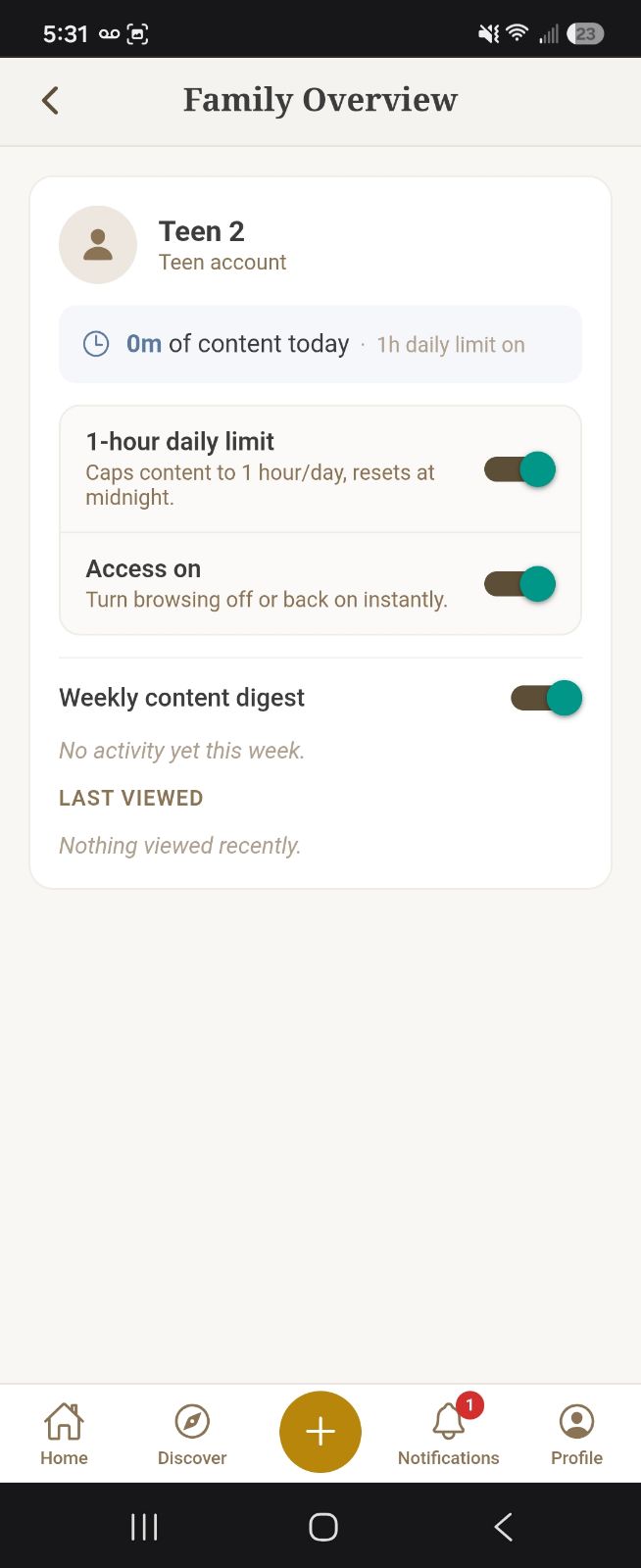
In a family group, each teen member has a one-hour daily content limit. When they reach it, browsing stops for the day. A parent in the group can turn the limit on or off for each teen, and can pause a teen's browsing straight away.
The teenager can't change it. This is the part most parental controls get wrong: a limit the person being limited can adjust is a suggestion, not a control.
A parent can also turn on a weekly digest in the Parent Dashboard showing what each teen viewed over the past seven days, so the conversation about screen time can be based on something rather than a guess.
Videos already in progress are allowed to finish rather than cutting off mid-way, because a hard stop in the middle of something is how features like this end up resented and circumvented.
No advertising aimed at anyone in your family
There is no advertising anywhere in Kindred. Not in the feed, not between posts, not targeted at teenagers.
This is the difference that matters most for families, and it isn't a setting: it's the funding model. Kindred is paid for by subscriptions, so there is no advertiser buying access to anyone's attention and no profile being built to sell.
The feed is chronological too, so there's no ranking system deciding what will hold a fourteen-year-old's attention longest.
Researchers have documented associations between heavy algorithmic social media use and adolescent anxiety, sleep disruption and attention difficulties. The American Psychological Association's health advisory on adolescent social media use is a measured summary of the evidence.
How family groups work
A family group has up to six people. Anyone 18 or over can start one for free, and the person who starts it is its owner.
The owner invites members by email or username, and each person joins by accepting the invitation. Everyone keeps their own account, feed and profile: a family group is not a shared account.
Members join as a parent or a teen. Parents must be 18 or over and teens 13 to 17; teens get the daily content limit and can appear in the weekly digest, and parents don't.
There is an optional Family plan, which makes every member of the group a paid member and funds the creators they watch. It is priced per person, for at least two people, and pricing is shown when you add it. The group and its controls are the same with or without it.
Kindred is 13 and over
Kindred requires everyone to be at least 13. A date of birth is collected when an account is created and enforced on our side, and accounts for anyone younger are refused.
The family features are built for households with teenagers: the parental controls exist because 13 to 17 is exactly the period where they're useful and most platforms offer parents nothing.
This isn't a children's platform, and we'd rather say so plainly than let the word family imply otherwise.
Content is moderated automatically on upload, and reporting and blocking are available on every post and profile.
Common questions
What age is Kindred for?
13 and over. A date of birth is collected at signup and enforced server-side; accounts for anyone under 13 are refused. The family features are designed for households with teenagers.
Are parental controls free?
Yes. Family accounts and parental controls are free. Start a family group, invite your teen, and the controls work without a subscription.
What does the Family plan add?
Nothing about the controls. The optional Family plan makes every member of your family group a paid member, which funds the creators they watch. It is priced per person, for at least two people, monthly or annually; pricing is shown when you add it, and it needs a payment method.
Can my teenager turn off the screen-time limit?
No. The daily content limit is set by a parent in the family group, and the teen it applies to can't change it.
Who can see our shared collections?
Only the people invited to them. Shared collections are private feeds: there's no public version of the post and no way for someone outside to find it.
Are there ads?
None, anywhere, for anyone. Kindred is funded by subscriptions rather than advertising, so there's no advertiser buying access to your family's attention.
Does everyone need their own account?
Yes. A family group is not a shared account: each member has their own feed, profile and posts.
Can grandparents join without being tech-savvy?
The invite is a link in an email, and Kindred works in a browser on any device. On a phone you can add it to the home screen and it behaves like an app.