Client work: still the reliable one
Weddings, portraits, commercial, editorial. It pays the most reliably and it's what the overwhelming majority of working photographers actually live on.
The catch is that it's a service business, not a photography business. Your income tracks how well you sell, schedule and follow up, and the photography is the smaller part of the job.
Social media helps here indirectly, it's a portfolio and a credibility signal, but the number that matters is enquiries, not followers. A photographer with 800 engaged local followers can book more work than one with 40,000 scattered globally.
If you want income this year, this is the answer, and everything below is supplementary.
Prints: small, but yours
Selling prints works, at a scale most people find disappointing. A few sales a month is typical for a photographer with a modest audience, and print-on-demand takes a meaningful cut of each.
It works best when the work has a clear subject people want on a wall, landscape, architecture, local scenes, and considerably worse for documentary or portraiture.
The advantage is that it's yours: no platform between you and the buyer, no policy change that removes the income overnight.
The realistic framing is supplementary income and a way to feel your work has a life beyond a feed, rather than a living.
Stock and licensing: a numbers game
Stock libraries pay pennies per download and require volume in the thousands of images to produce meaningful income. For most photographers the maths doesn't work.
Direct licensing pays far better, a single editorial or commercial licence can be worth more than a year of stock, but it requires the kind of archive and relationships that take years to build.
Generative AI has made the low end considerably worse, and that trend isn't reversing.
Worth doing if you already have a large archive sitting idle. Not worth building a strategy around from a standing start.
Teaching: the highest ceiling
Workshops, courses, one-to-one tuition, presets, ebooks. Photographers who do well online almost always do it here.
It pays well because you're selling something with no marginal cost to a person who already trusts your eye. A course that takes six weeks to make can sell for years.
It requires an audience that believes you know something, which is why it usually follows building a following rather than preceding it.
It also isn't photography. Plenty of photographers who make good money teaching describe shooting less than they used to, and mind that more than they expected.
Brand deals: narrow and getting narrower
Camera companies, film brands, travel boards. Real money for the photographers who get it, and inaccessible to almost everyone else.
Brands buy audience, not craft, and they buy it in formats that perform on ranked feeds. That pushes toward lifestyle content: you in the frame, gear visible, delivered vertically.
It also changes what you shoot, in ways that are hard to reverse. This is the route most likely to leave you making work you don't want to make.
If it comes, take it. It's a poor thing to build a plan around.
Platform revenue share: new, small, and honest about it
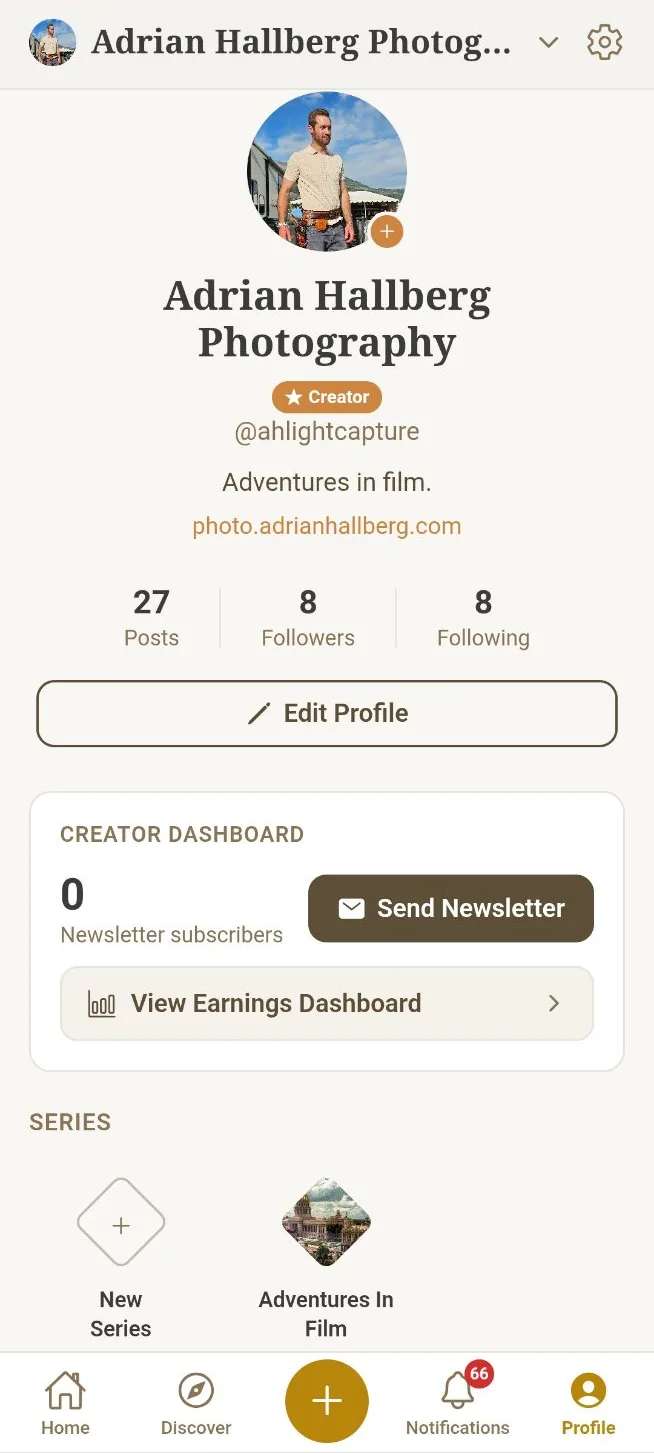
Some platforms share subscription revenue with the creators whose work people came to see. This is what Kindred does: 35% of subscription revenue, after payment processing, split among creators monthly based on watch time, impressions and engagement.
What's different from ad revenue sharing is where the money comes from. Ad revenue pays you for holding attention, so it rewards whatever holds attention longest. Subscription revenue pays you from people who chose to pay for the content, which is a closer match to what a photograph is actually worth.
What's honest about the current state: Kindred is small, so the pool is small. The share grows as the subscriber base does, which is why joining early means a stake in that growing rather than a large cheque today.
The first 1,000 creators join free for a year with no follower requirement. If you want to see how the earnings work before deciding, the founding creator page covers it.
What actually works for most photographers
Client work for income, teaching for leverage, and everything else as supplementary. That's the honest shape of it for the large majority.
The one thing worth doing regardless of route: build a direct relationship with your audience that doesn't depend on a platform's ranking. An email list is the unglamorous answer and it works better than anything else on this page.
Follower count is the least useful number in this whole discussion. A thousand people who open your emails are worth more than fifty thousand who scrolled past you once.
And be sceptical of anyone selling you a system. Photography income is slow, uneven and built from several small streams, and any page telling you otherwise is selling the course.
Common questions
How many followers do I need to make money from photography?
For client work, almost none: local visibility matters more than follower count. For teaching, a few thousand engaged people is usually enough. For brand deals, tens of thousands and the right format.
Do photographers make money from Instagram directly?
Very few. Instagram's creator monetisation favours short-form video and large accounts. Most photographers earning through Instagram are earning from clients or courses that Instagram introduced them to, not from Instagram itself.
Is selling prints worth it?
As supplementary income, yes. As a living, rarely. A few sales a month is typical for a modest audience, and print-on-demand takes a meaningful cut.
What's the fastest route to income?
Client work. It's a service business rather than a photography business, which is the part people find disappointing, but it pays reliably and doesn't require an audience.
How does Kindred's revenue share work?
35% of subscription revenue, after payment processing, is shared among creators monthly based on watch time, impressions and engagement. Payouts run via Stripe once you've accumulated $10. It's a small platform, so the pool is currently small.